Ceiling Lights
In the FormAdore shop we know that you can have an uneven ceiling, but you can just as well have an even, calm, extravagant one.... You can have it how you want it! That is why you will find everything in our range of ceiling lights: both large pendant lights, including impressive chandeliers, which are perfect as table lamps, and space-saving plafonds. We also have ceiling lights and strips ideal for modern and office spaces.
We don't know what you're looking for, but we know you're sure to find it with us. A modern lamp for a minimalist interior? No problem. An industrial lamp for a loft-style interior? Nothing easier! And if you get bored with the look of your ceiling lamp, experiment with accessories: change the lampshade or the suspension, or maybe just replace the bulb with a decorative one? Feel free to experiment!

Trends, new products and ideas.


Ceiling Lamps - Your Comprehensive Guide to Choosing the Perfect Light
Ceiling lamps are often the main source of illumination in almost every room – from the living room and kitchen to the bathroom. They are responsible for evenly lighting the space and allowing you to go about your daily activities with ease. At the same time, they significantly influence the interior's atmosphere: the light color, shade shape, or material can transform a room from cool to cozy, or from cramped to spacious.
Choosing the right ceiling lamp is both an aesthetic and a purely practical matter. Inappropriately selected lighting can lead to visual discomfort, distorted colors in the interior, and even disruptions to your circadian rhythm.
Types of Ceiling Lamps
The ceiling lamp category encompasses many types of fixtures (including pendant lamps), which differ in construction, mounting method, and purpose. Below, we present the most important types – each serves different practical and decorative functions, so it's worth getting to know their characteristics before making a decision.
Flush Mount Lights
Flush mount lights are lamps mounted directly to the ceiling, adhering to it with their entire body or a significant part of it. Thanks to their low profile, they don't eat up valuable inches of room height, making them ideal for rooms with low ceilings (up to approx. 2.5–2.6 m).
They work wonderfully in hallways, corridors, bathrooms, and smaller rooms. LED flush mounts combine aesthetics with functionality in modern homes – they provide even illumination while maintaining a simple, unobtrusive form. Available models include round, square, with milky glass or frosted plastic diffusing the light.
Chandeliers
Chandeliers are decorative pendant fixtures, equipped with arms and multiple light points – these ceiling lamps can have anywhere from a few to a dozen light sources. Chandeliers play both a decorative and an illuminating role in living rooms, dining rooms, and other representative spaces.
Chandeliers add elegance and luxury to interiors, becoming the central focal point of the decor. They are available in both classic forms – with crystals, ornate shades, and multi-arm structures – and modern ones: geometric, industrial, minimalist. Pendant lamps are best suited for high-ceilinged rooms, where a long drop isn't an obstacle and allows the fixture's form to be fully showcased.
Ceiling Spotlights
Spotlights are point lighting fixtures, often with adjustable beam angles. Spotlights are perfect for accent lighting – they excel at illuminating specific zones: artwork on walls, kitchen countertops, a workspace in a study, or architectural features. Spots and spotlights allow you to direct light to chosen areas, offering the ability to sculpt space and highlight details. Recessed spotlights provide discreet and even illumination – they can be surface-mounted or embedded in a suspended ceiling, maintaining a minimalist character.
Track Lighting Systems
Track lighting systems (also known as lighting tracks or rail lighting) are a flexible solution involving the mounting of a track to the ceiling, onto which movable spotlights or fixtures are placed. Track systems allow for flexible lighting management – you can easily change the number and position of lamps on the track depending on current needs. This is an ideal solution for multi-functional rooms: open-plan kitchens and living rooms, home galleries, office spaces, or art studios. The tracks can come in various shapes and finishes, allowing them to be matched to the interior decor.
LED Panels
LED panels are modern ceiling lamps with a flat design, most often installed in suspended ceilings or directly on the ceiling surface as a surface-mounted element. They are characterized by high light output, providing uniform illumination over a large area, while maintaining a minimalist, neat appearance. LED panels are primarily used in offices, kitchens, and modern interiors where maximum functionality and energy saving are key.
LED ceiling lamps are more energy-efficient than traditional bulbs, making panels one of the most ecological lighting solutions.
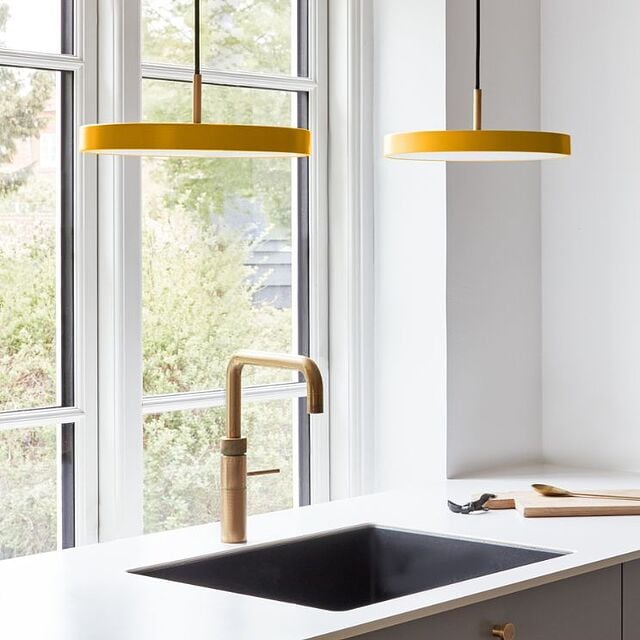
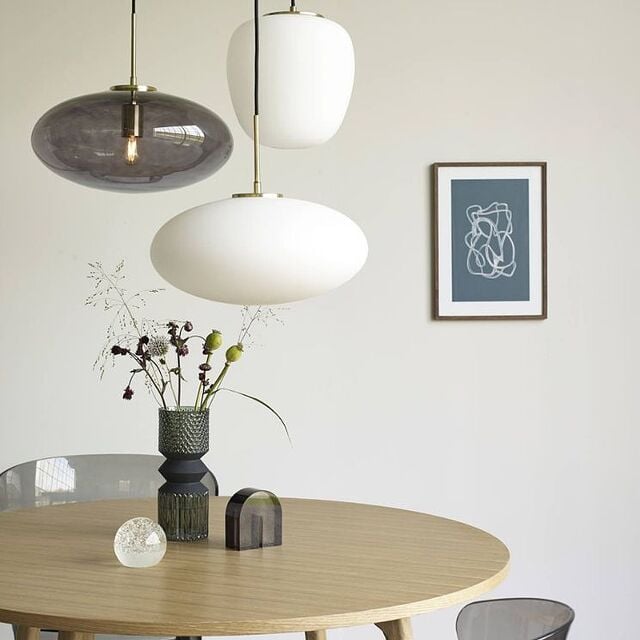


What to Look for When Choosing Ceiling Lamps
Beyond aesthetics, a range of technical and functional parameters determine the suitability of a ceiling lamp. Understanding these features allows you to select lighting that will serve you for years and provide the right amount of light in every room.
Light Output and Brightness
A key parameter for a ceiling lamp is the luminous flux, expressed in lumens (lm) – this indicates how much light the source actually emits. The illuminance, measured in lux (lx), tells us how many lumens fall on a square meter of surface. We recommend 100 to 150 lumens per square meter as a starting point, but the exact values depend on the room's function:
Living Room – general lighting 200–300 lm/m², for tasks requiring concentration (e.g., reading), up to 400 lx.
Kitchen – general lighting 300–400 lm/m²; worktops 500–750 lx.
Bedroom – softer, around 100–200 lm/m² is sufficient for comfort.
Bathroom – up to 600 lm/m², especially above the mirror 300–500 lx.
Ceiling lamps can have anywhere from a few to a dozen light sources, allowing you to adjust the total number of lumens to the needs of a given room.
Light Color Temperature
Light color temperature is measured in Kelvin (K) and has a huge impact on the atmosphere and functionality of an interior. We distinguish three main ranges:
Warm White (2700–3000 K) – a warm light color of 2700–3000 K is suitable for the living room and bedroom. Studies confirm that at 2700 K, people perceive the light as more pleasant, comfortable, and conducive to relaxation.
Neutral White (3500–4000 K) – has a stimulating effect, works well in kitchens and home offices where better visibility of details is important for daily tasks.
Cool White (above 5000 K) – provides high visibility but can be tiring in large doses; primarily used in technical spaces.
Equally important is the Color Rendering Index (CRI). A CRI ≥ 80–90 guarantees faithful color reproduction, which is significant, for example, in the living room when selecting decor elements or in the bathroom above the mirror. A low CRI makes the color of clothes, skin, or furniture appear distorted.
IP Protection Rating
The IP (Ingress Protection) rating specifies the fixture's sealing against dust and water – it's a safety class expressed by two digits. In typical, dry rooms of the house – living room, bedroom, study – an IP20 rating is sufficient. The situation is quite different in the bathroom:
Zone 0 (inside the bath/shower) – IP67 required.
Zone 1 (above the bath/shower up to 2.25 m) – IP65 required.
Zone 2 (around the sink, approx. 60 cm) – minimum IP44.
Rest of the bathroom – minimum IP44.
The PN-HD 60364-7-701 standard precisely divides the bathroom into zones and assigns required protection classes to them, so before purchasing a lamp for the bathroom, it's worth checking which zone it will be installed in.
Materials
The material a ceiling lamp is made from affects its durability, aesthetics, and ease of cleaning. The most popular materials include:
Metal – adds a loft or industrial style, is durable and easy to clean. Industrial-style lamps feature metal frames and raw finishes.
Glass – milky shades diffuse light, creating a soft glow; transparent ones expose the light source. Mid-Century Modern lamps often feature milky glass and brass frames.
Wood – imparts a natural, warm character, suits Scandinavian interiors, but requires protection from moisture.
Plastic – offers lightness, lower cost, and variety of forms; a good option for imitating more expensive materials.
Each of these materials suits a different interior style – it's a matter of individual preference and the conditions prevailing in the room.
Additional Features
Modern ceiling lamps are not just a source of light – many models offer advanced practical features that significantly enhance user comfort:
Dimming – some ceiling lamps offer brightness adjustment, allowing you to tailor the light intensity to the situation: a bright example is evening relaxation in the living room versus morning routines.
Color Temperature Change – ceiling lamps can change the color of light within a single fixture, transitioning from warm to cool white.
Remote Control – ceiling lamps can have a remote control function; LED ceiling lamps can be operated via a remote or a smartphone app.
Motion Sensors – ceiling lamps with motion sensors automatically turn on the light, which is particularly useful in corridors, stairwells, and bathrooms.
LED ceiling lamps can have built-in LED diodes or replaceable light sources – the first solution ensures consistent parameters, while the second offers the possibility of future replacement.
How to Choose the Right Ceiling Lamp
Choosing a ceiling lamp depends on several key factors that should be considered together, not in isolation:
Room Size – in small rooms, compact ceiling lamps like flush mounts or spotlights will suffice. Large living room or dining room spaces allow for chandeliers and multi-point systems that provide adequate light across the entire area.
Ceiling Height – the choice of ceiling lamp depends on the room's height. Ceiling lamps should match the room's height: for low ceilings (up to 2.5 m), flat flush mounts or recessed spotlights are necessary, while rooms with a height of 3 m or more allow for impressive pendant lamps and elaborate chandeliers.
Room Function – the living room is a multi-functional space requiring versatile lighting with zoning options; the kitchen needs bright, functional light, especially over worktops; the bedroom – cozy, dimmable lighting in a warm color; the bathroom – bright, color-accurate light with an appropriate IP rating.
Interior Style – modern ceiling lamps feature simple forms and functionality; minimalist interiors require LED fixtures without unnecessary embellishments. Ceiling lamps come in styles such as Scandinavian and retro. Classic interiors benefit from elegant chandeliers with crystals, while lofts thrive with raw, metal fixtures. Ceiling lamps can have various styles, from minimalist to glamour.
Technical Requirements – depending on the room, check the IP rating, power supply type, and compliance. In bathrooms, the IP protection class is crucial, and in corridors, motion sensor models are worth considering.
Frequently Asked Questions
Which ceiling lamp should I choose for the living room?
For a medium-sized living room (20–30 m²), a chandelier that serves both a utilitarian and decorative function, or a large flush mount providing even illumination, would be an excellent choice. It's worth planning to combine main lighting with additional lighting – for example, a chandelier as a central point plus spotlights or floor lamps for accent lighting. A warm light color of 2700–3000 K will make the living room cozy and conducive to relaxation, and dimmable models will allow you to adjust the mood depending on the occasion.
Are LED ceiling lamps better than traditional ones?
LED ceiling lamps are more energy-efficient than traditional bulbs – they achieve an efficiency of over 80–100 lumens per watt, whereas classic bulbs provide significantly less light for the same power. The lifespan of LED diodes is longer than traditional bulbs – LEDs don't burn out suddenly but slowly lose brightness (known as lumen depreciation). Good LED lamps retain ≥ 80% of their luminous flux (L80 parameter) for 50,000–100,000 operating hours. The energy efficiency of LEDs translates into savings on electricity bills, and their ecological features – lower energy consumption and no mercury – make them the preferred choice in modern homes. LED ceiling lamps provide uniform room illumination thanks to precise optics.
What IP rating should a bathroom lamp have?
The requirements depend on the bathroom zone. Inside the bath or shower cabin (Zone 0), an IP67 rating is needed; directly above the bath or shower up to 2.25 m (Zone 1) – IP65; around the sink (Zone 2, approx. 60 cm) – a minimum of IP44. In the rest of the bathroom, at least IP44 is also recommended. Before purchasing, check which zone you intend to install the lamp in and compare the parameters of available models with the requirements of the PN-HD 60364-7-701 standard.
How to choose the right lamp size for a room?
A useful rule of thumb suggests that the diameter of the lamp (e.g., a chandelier) in centimeters should roughly correspond to the room's area in square meters – for a 20 m² room, a lamp with a diameter of about 20 cm would be suitable (though depending on the style, it could be larger). Pendant lamps over a table should be hung at a height of about 60–70 cm above the tabletop so that the light effectively illuminates the table without dazzling those seated. For low ceilings, opt for flush mounts and low-profile models, while in high-ceilinged rooms, you can indulge in more elaborate forms with a pronounced drop.
Summary
Ceiling lamps serve both utilitarian and decorative functions simultaneously – choosing the right fixture impacts visual comfort, atmosphere, and the daily perception of every room in your home. Before making a decision, consider the ceiling height, room size and function, the required amount of light, the necessary IP rating, and the interior style. Pay attention to the light color temperature, CRI, and dimming capability – these details are what make the lighting truly tailored to your needs. Reflect on your individual requirements, compare available solutions, and choose a lamp that will combine aesthetics with functionality for years to come.