You'd think cutting cheese would be a piece of cake. After all, all we have to do is pick up a knife and cut. But will any knife do the trick when it comes to a sophisticated and demanding product like cheese? Why is choosing the right cheese knife so important? Find out how and with what to cut cheeses.
Classification and types of cheese
Cheese...
...is one of the most popular food products in the world. Cheeses differ in their composition, production method, and the type of milk from which they are made.
The basic classification of cheeses is by the type of milk used. On this basis, we distinguish cheeses made from cow's, sheep's, and goat's milk.
The production of cheese at the initial stage, regardless of the type, always looks the same and consists of balancing the fat content in the milk and pasteurising it. Then, appropriate bacteria are added to the milk. Subsequent stages of production depend on the type of cheese. Due to production, there are four main types of cheese:
- rennet cheeses – rennet is added to the milk;
- acid-set cheeses – curdled with milk bacterial cultures;
- acid-rennet cheeses – the production of these cheeses combines both of the above methods;
- whey cheeses – made from whey.


Rennet cheeses
Rennet cheeses can be divided into hard, semi-hard, and soft cheeses. Acid-set cheeses include various types of cottage cheeses, while acid-rennet cheeses come in the form of homogenised and farmer's cheeses, and the most popular example of whey cheese is ricotta.
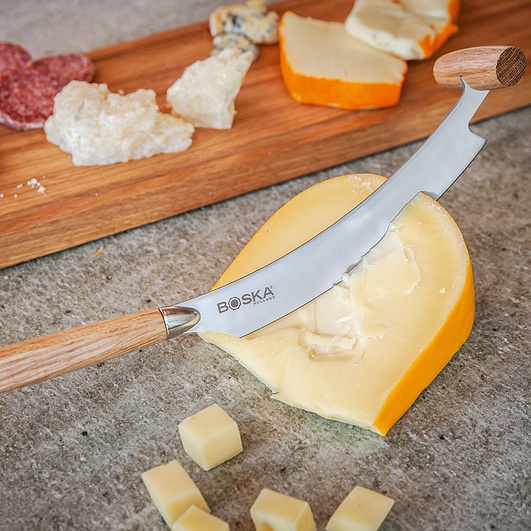
Cheese is an exquisite delicacy that we consume in various forms. A fondue set allows you to revel in the taste of melted, stringy, delicious cheese. Finely grated cheese can enhance the flavour of pasta dishes or salads. On the other hand, a traditional French cheese board requires serving various types of cheese cut into even and aesthetically pleasing pieces. Portioning and serving cheeses will be easier and more convenient if we equip ourselves with specialised cheese knives. Different cheese knives are designed for different types of cheese, with their shape adapted to the consistency and form of the product. Therefore, cutting tools can be divided into two groups: knives for soft cheeses and knives for hard and semi-hard cheeses. Furthermore, wire cheese slicers, cheese cutters, and cheese planes come in handy. Cheese planes are excellent for slicing cheese into thin slices or arbitrarily chosen shapes.

Interesting!
Knives for hard and semi-hard cheeses
As the name suggests, hard cheeses are products with a firm, solid texture and most often a savoury taste. Hard cheeses can be divided into two categories:
- hard cheeses such as chevrette, Grana Padano, Rubin, Parmesan, or Pecorino Romano;
- semi-hard cheeses, among which the following varieties are listed: Gouda, Cheddar, Edam, Mimolette.
In the production of the aforementioned cheeses, most of the whey is separated, which is why both hard and semi-hard cheeses are characterised by a water content below 50%. These types of cheeses mature from 2 to 36 months, and some varieties even longer. It is precisely the ripening time that determines the intensity of their flavour. Long-aged cheeses are brittle and aromatic, while those that mature for a shorter period are more delicate and creamy.
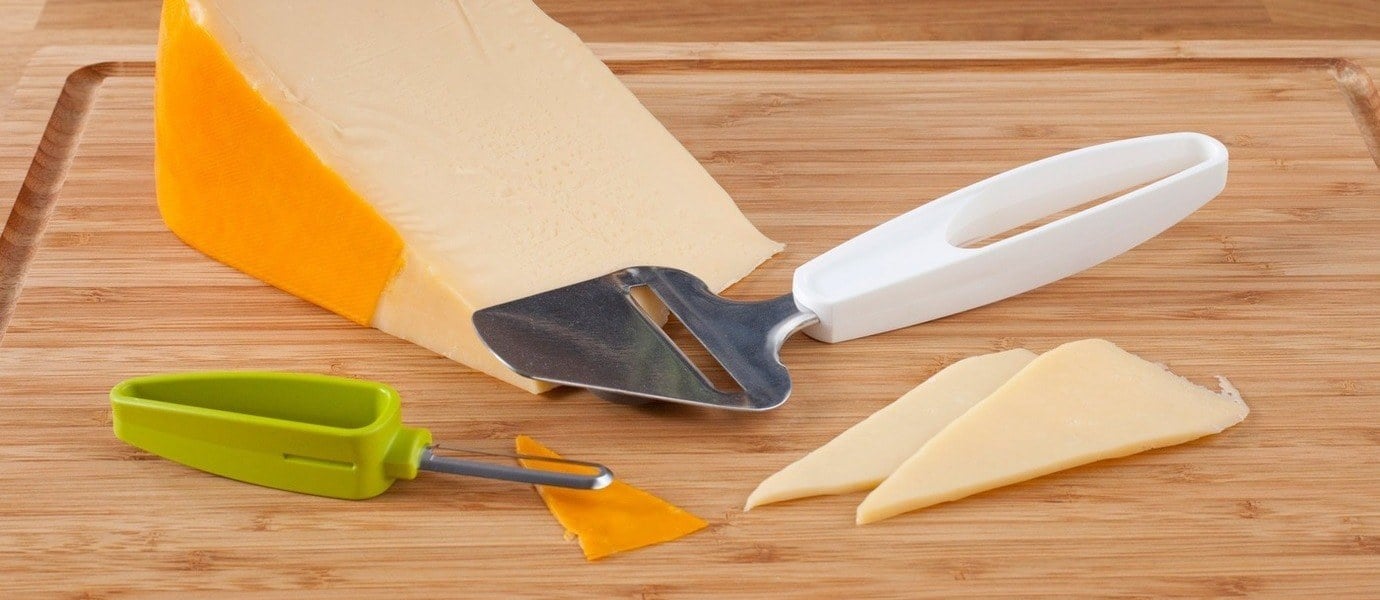

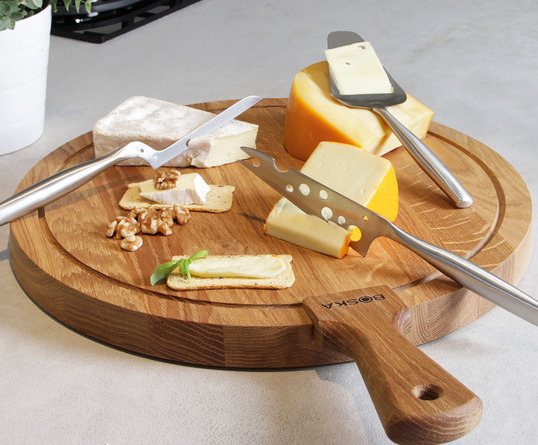
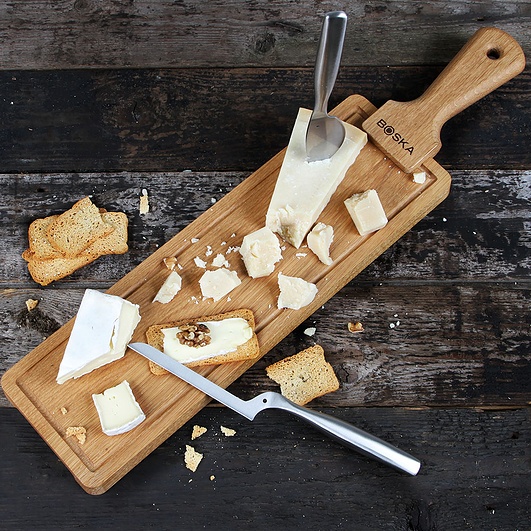
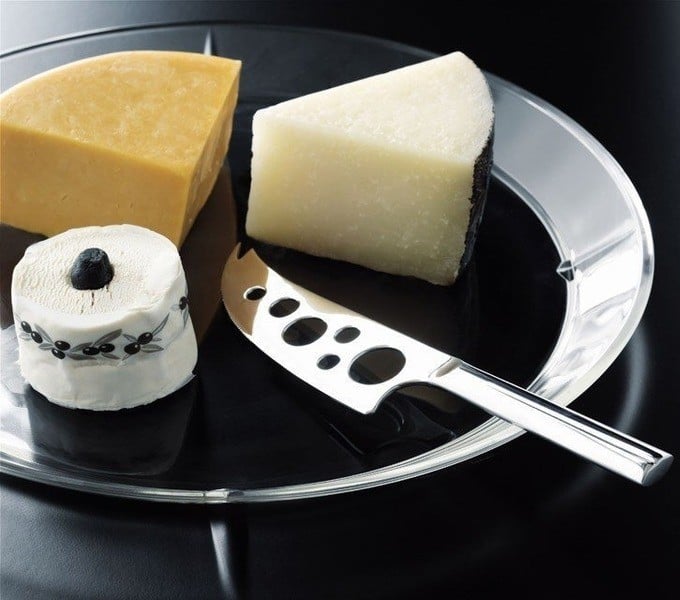
Therefore, a hard cheese knife must primarily feature a good quality blade, i.e., one that can handle portioning and cutting even the hardest types of cheese into smaller pieces. Knives for hard and semi-hard cheeses have a handle longer than the blade and often have a sharp tip, allowing them to pierce the cheese and lift sliced pieces. Some models have a small, rectangular hole in the blade. A hard and semi-hard cheese knife usually comes in the form of a cleaver or a triangular spatula.


It is also worth noting that the way we cut a particular type of cheese is not without significance. Why? Because cheeses, depending on their shape, mature differently. The taste and consistency of cheese vary within a single piece. The cheese near the rind has a different taste and texture than the one in the middle. Hard and semi-hard cheeses usually come in the form of narrow wedges or thicker slices. These cheeses should be cut from the centre towards the rind. If a double piece remains, we cut it perpendicular to the edge. Thanks to this trick, we won't be left with just the rind at the end.
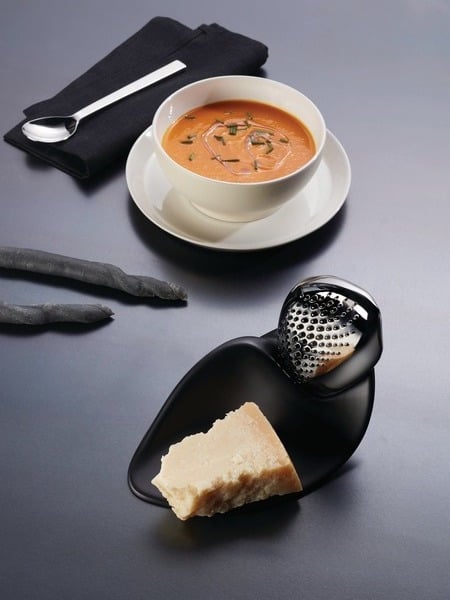
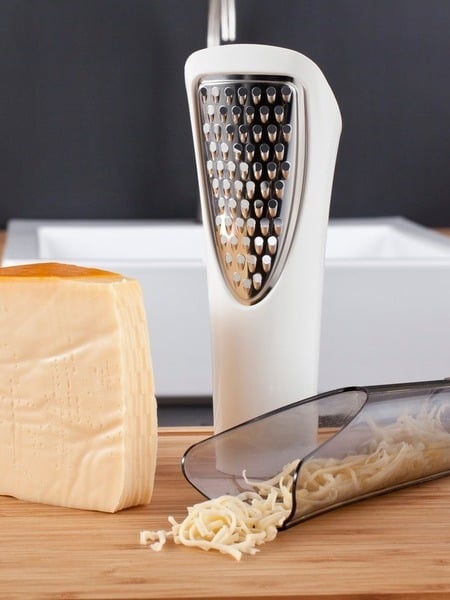
A hard cheese knife will certainly come in handy for portioning and serving this product on a cheese board. However, hard cheeses are often added to dishes in grated form. In this case, you will need a cheese grater, with the help of which you can quickly and conveniently grate cheese for spaghetti or risotto.

Knives for soft cheeses
The ripening process of soft cheeses proceeds from the surface to the centre, under the influence of appropriate moulds and bacteria. There are three types of soft cheeses:
- bloomy rind cheeses – covered with a white, mouldy rind; the most popular varieties include Brie and Camembert.
- blue cheeses – these cheeses have a network of blue-green veins inside, e.g., Gorgonzola, Roquefort, and other blue cheeses.
- smear-ripened cheeses – made from sheep's milk, e.g., Bryndza.
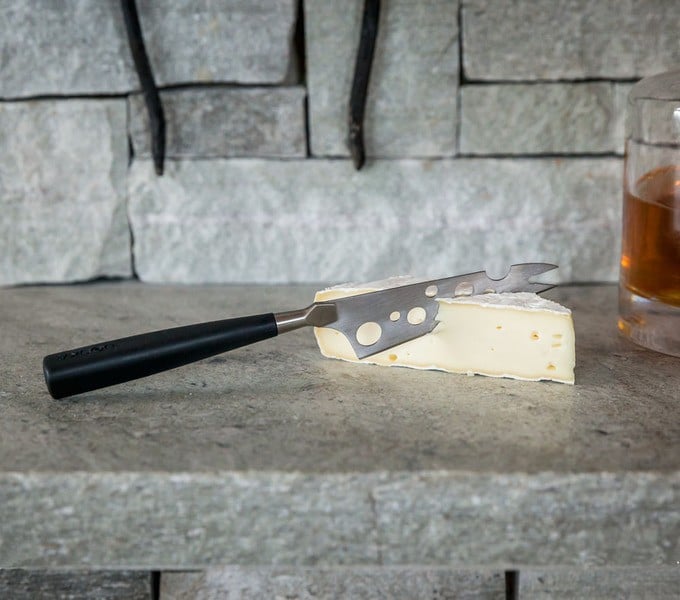
Soft cheeses are difficult to cut due to their consistency. They contain a large amount of water, which causes them to stick to the blade or deform unpleasantly when cut. Therefore, a soft cheese knife is characterised by a rather specific design. The tip of such tools has a special fork, and the blade is serrated along its entire length or part of the knife. They also have many holes in the blade, thanks to which cheeses do not stick to the knife blade, which greatly facilitates portioning them into even and nicely presented pieces.


Just as with hard and semi-hard cheeses, the way you cut soft cheeses is important. Soft cheeses usually come in flat and round shapes. Such cheese should be cut like a cake, placing the knife in the centre of the cheese and moving outwards. If we only buy a slice of a large, round cheese, we get a triangular piece. In this case, care should be taken not to cut off the 'nose' of the cheese, as this is precisely the creamiest and most delicate part. The delicacy removed from its cheese keeper should be cut along its longest side so that everyone can enjoy the aromatic centre. Blue cheeses, which are sold in smaller pieces, should be cut from the centre, moving towards the smaller edge. Once cut, the cheese should resemble a fan.


Cheese slicers and wire knives
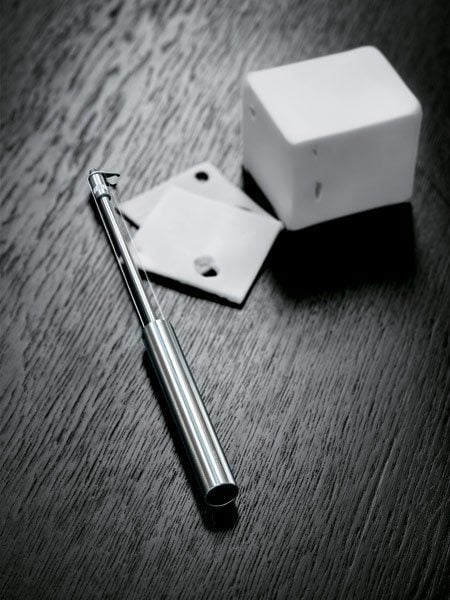
High-quality knives are not the only tools that can quickly and conveniently cut cheese. Wire cheese slicers come to the rescue. Between the metal frame of the slicer, a tightly stretched, thin wire is strung, which can easily cut cheese. A wire knife works on a similar principle, consisting of a frame and a very sharp string, allowing precise slicing of semi-hard and soft cheese into slices or smaller pieces. When using either a slicer or a wire knife, one must be very careful, as these are very sharp tools.

Ensure convenient portioning and serving of cheeses and get yourself a specialised cheese knife made from the highest quality materials today.