Kitchen Knives
108 products


£78.66
Zwilling Twin Stone Pro 250/1000 Knifeblade sharpening stone
Zwilling
Dispatch within 45 working days


£118.08
Zwilling Twin Stone Pro 4.2 Knifeblade sharpening stone
Zwilling
Dispatch within 45 working days


Trends, new products and ideas.



Kitchen Knives - An Essential in Every Kitchen
A good kitchen knife, alongside pots and pans, is the most crucial accessory. It's like a brush in a painter's hand – a tool that transforms ordinary ingredients into a work of art. Imagine that satisfying sound as a perfectly sharp blade glides through a ripe tomato, without crushing its delicate structure. Inhale the aroma of freshly chopped herbs, their scent wafting through the air, promising an extraordinary dish. This is the magic of cooking, where the knife plays a pivotal role.
Choosing the right knife isn't just a technical matter; it's a decision that impacts comfort, safety, and most importantly – the joy of cooking. How do you pick the best ones, what makes the renowned Japanese knives so special, and how do you care for your blades so they serve you for years, maintaining impeccable sharpness? Read on before you buy.
The Best Kitchen Knives
The best kitchen knives are those that fit perfectly in your hand, suit your cooking style, and match the type of dishes you prepare. There isn't a one-size-fits-all knife set for everyone, but there are a few key characteristics that define a high-quality knife: excellent balance, blade durability, and a comfortable handle.
Investing in good knives is one of the most important decisions you'll make when setting up your culinary space. Instead of buying a large set of cheap knives that will quickly dull and frustrate you, it's better to start with a few basic, but solid, tools. The foundation is a chef's knife – versatile and indispensable. To complement this, it's worth adding a smaller utility knife for vegetables and fruits and a serrated bread knife. This "holy trinity" will handle most kitchen tasks with ease.
What to Look for When Choosing Kitchen Knives?
When choosing knives, pay attention to four key elements: the type of steel the blade is made from, its hardness (expressed in HRC scale), the knife's balance, and the material and ergonomics of the handle. These factors will determine how the knife feels in your hand and how long it will retain its sharpness.
Let's take a closer look at these aspects:
Steel: This is the heart of the knife. Stainless steel knives are the most popular, being corrosion-resistant and easy to maintain. More demanding chefs often opt for carbon steel knives, which are harder and hold their edge longer, but require careful maintenance to prevent rust. Modern high-carbon steels offer a compromise, combining the advantages of both types.
Hardness (HRC): The Rockwell scale (HRC) measures steel hardness. Good quality European knives have a hardness in the range of 55-58 HRC. Japanese knives are significantly harder, often reaching 60 HRC and above. Higher hardness means the knife stays sharp longer, but it is also more brittle and prone to chipping.
Balance: A perfectly balanced knife is one where the center of gravity is located at the junction of the blade and the handle. To check this, place the knife on your index finger at this very point – it should not tip forward or backward. Good balance means less hand fatigue and greater cutting precision.
Handle: It must sit securely in your hand, even when wet. Materials vary – from traditional wood (beautiful, but demanding), to plastics (practical and hygienic), to stainless steel. Choose one that best fits the size and shape of your hand.
Types of Kitchen Knives
The world of knives is incredibly rich, but to start, it's enough to know a few basic types that form the foundation of a well-equipped kitchen. Over time, as your passion and skills develop, you can expand your collection with more specialized blades.
Here's a list of the most important players on the kitchen cutting board:
Basic Kitchen Knives:
Chef's knife: The most important and versatile knife. With a wide, slightly curved blade (usually 20 cm), it's ideal for chopping, slicing, and dicing most ingredients – from vegetables to meat.
Paring knife: (vegetable/fruit knife): A small (8-10 cm), handy knife with a short blade. Indispensable for peeling, coring, and all precise tasks performed "in the air," holding the product in your hand.
Bread knife: A long knife with a serrated blade. It easily handles tough bread crusts without crushing the delicate crumb. It also works great for slicing tomatoes or citrus fruits.
Knives for Enthusiasts and Professionals:
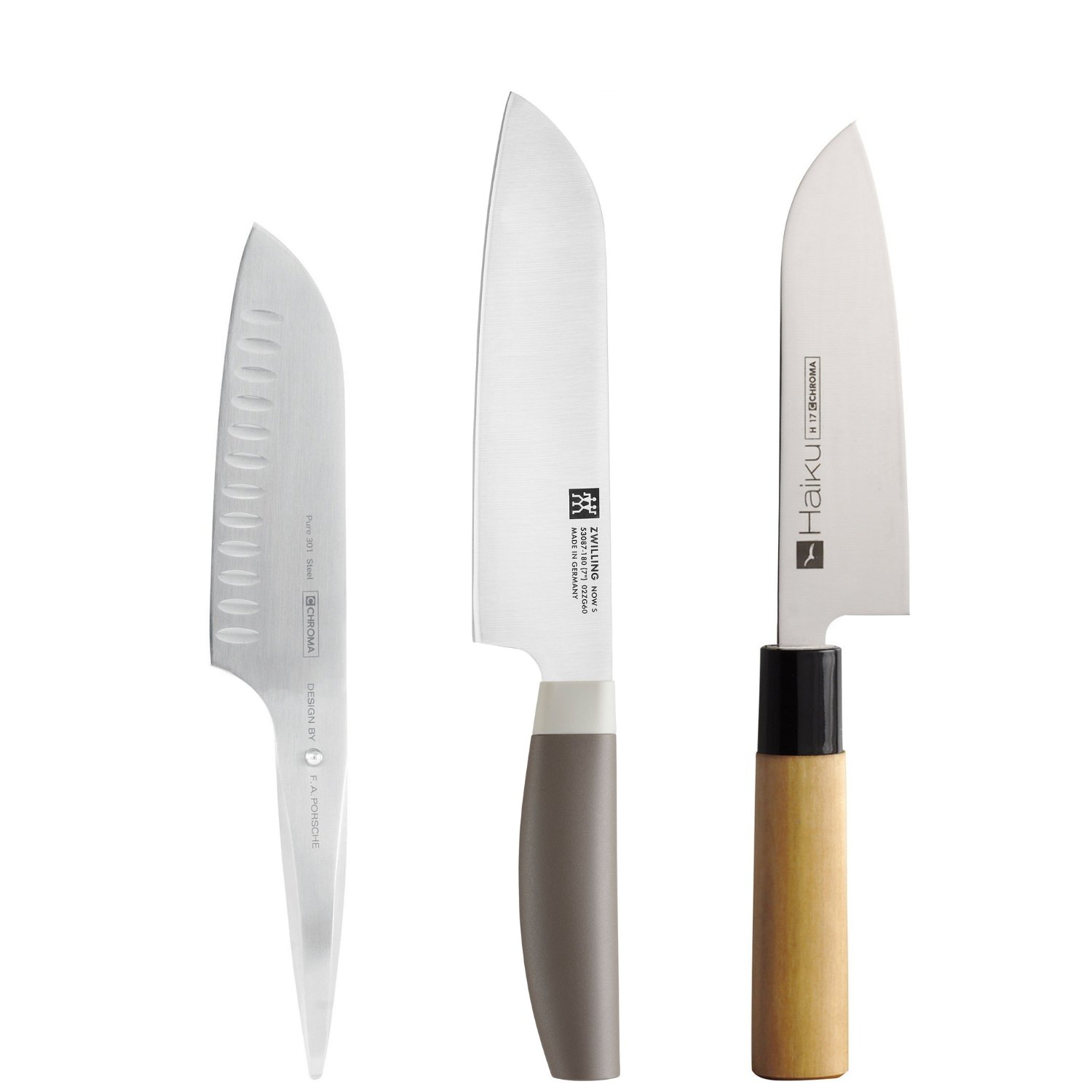
Santoku knife: The Japanese equivalent of a chef's knife. It's slightly shorter, and its blade has a gentler curve. Characteristic indentations on the blade prevent food from sticking. Ideal for chopping and slicing thinly.
Filleting knife: A long, very thin, and flexible knife that allows for precise separation of meat from bones and skin in fish.
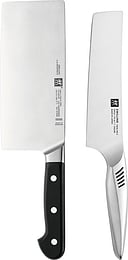
Cleaver: A heavy, powerful knife with a rectangular blade, designed for chopping bones and portioning large cuts of meat.
Japanese Kitchen Knives
Japanese kitchen knives are synonymous with extraordinary sharpness, precision, and beauty. They are distinguished by thinner, harder blades, ground at a smaller angle (usually 10-15 degrees per side), which allows for incredibly precise cuts. These are tools crafted for enthusiasts who appreciate finesse in the kitchen.
The tradition of forging Japanese knives stems directly from samurai swords. It's a combination of masterful craftsmanship and advanced metallurgy. Characteristic features include specialized shapes, such as Santoku (versatile, ideal for chopping vegetables), Gyuto (the equivalent of a chef's knife), or Nakiri (a rectangular vegetable knife). The steel used in their production, such as VG-10 or powdered steels, achieves very high hardness, which translates into legendary sharpness. Owning a Japanese knife is not just about functionality, but also aesthetics – many of them, like those made from Damascus steel, have beautiful, wavy patterns on the blade.


How to Care for Kitchen Knives?
Proper knife care is the guarantee of their longevity and sharpness. Key principles include: hand washing, regular sharpening, and appropriate storage. Never wash good knives in the dishwasher!
When caring for your knives, follow a few simple rules:
Washing and Drying: Always hand wash knives immediately after use, in warm water with a mild detergent. High temperatures and aggressive chemicals in the dishwasher damage both the blade and the handle. After washing, immediately wipe the knife dry with a soft cloth.
Sharpening: Every knife, even the best, dulls over time. Regular honing on a sharpening stone or steel (honing steel) will help maintain the cutting edge in good condition. Every now and then, a knife will require thorough sharpening on water stones or using a professional sharpener. The sharpening angle is crucial – for European knives it's about 20 degrees, for Japanese knives 10-15 degrees.
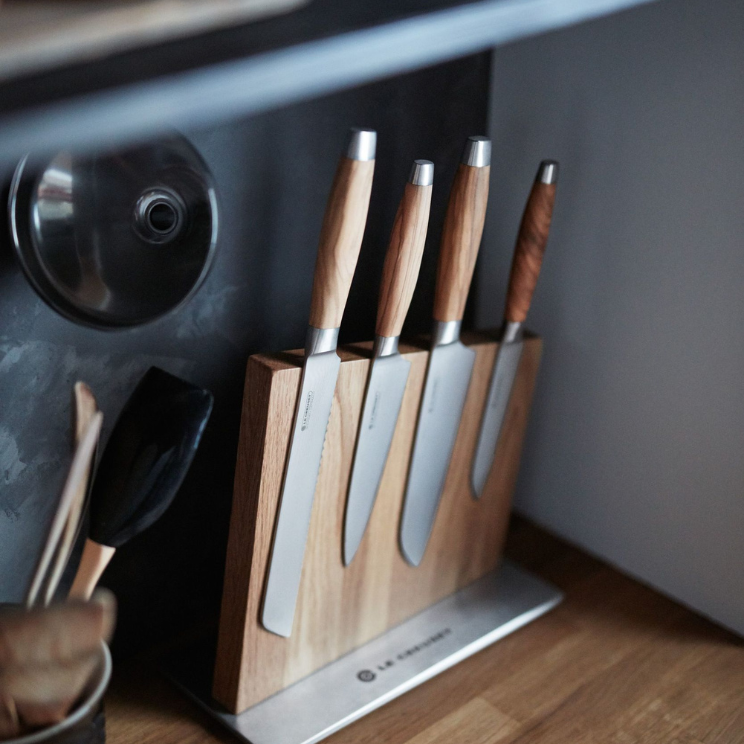
Storage: Never throw knives loosely into a drawer! Blades will knock against each other, leading to dulling and damage. The best solution is a knife block or magnetic strip. They protect the blades and provide safe access.
Cutting board: Use wooden or plastic cutting boards. They are "soft" on the blade. Avoid cutting on glass, stone, or ceramic boards – this is the quickest way to dull a knife.
Kitchen Knives for Cutting - Ingredients and Blade Type
Choosing the right knife for a specific product is key to efficiency and aesthetics in the kitchen. Using the correct blade not only makes work easier but also helps preserve the texture and flavor of ingredients, from delicate herbs to tough root vegetables.
Every ingredient has its own specifics. For slicing crusty bread with a hard crust, a serrated knife will be ideal, cutting through it without crushing the soft interior. For filleting fish, you need a long, thin, and flexible blade. A small, handy paring knife will be indispensable for peeling and precisely cutting vegetables and fruits. On the other hand, the wide blade of a Santoku or Nakiri knife will work perfectly for shredding cabbage or chopping large quantities of vegetables. Remember that a knife is a specialist – using it for its intended purpose shows respect for the tool and for the food itself.
Good Quality Kitchen Knives - What Makes Them So?
A good knife is an investment that pays off, but how do you recognize true quality? It's a combination of excellent materials, thoughtful design, and careful craftsmanship. Such a knife will not only be incredibly sharp but also comfortable, safe, and durable.
When looking for a high-quality knife, check if it has the following features: it is forged from a single piece of high-carbon steel (a full tang construction), has a blade with a hardness of at least 55 HRC, is perfectly balanced, and its handle sits securely and comfortably in the hand, without any gaps at the joints. A good quality knife gives you a feeling of solidity and precision that you'll recognize as soon as you pick it up.