Toy Storage
Storing toys doesn't have to be a headache! For big teddy bears and wooden cars, there's the right toy bin. toy baskets. And in cute little boxes cute little boxes small cute boxes are perfect for small things like key rings, sweets or crayons. In FormAdore you will find toy boxes in various colours and sizes; striped, dotted and with friendly animals; with or without lids. Freestanding and ones to hang on the wall or door. Sounds good, doesn't it?
Don't wait for your little one's toys to clutter up their whole room. Opt for head-turning storage, i.e. a functional toy box that can accommodate their entire arsenal of toys. Tidiness should be taught from an early age, because as the saying goes - what Johnny doesn't learn.... :)
17 products


Trends, new products and ideas.


Toy Storage – How to Choose a Functional and Stylish Solution for Your Child's Room
Daily tidying up a child's room can feel like an uphill battle. Toys scattered across the entire home, building blocks under the sofa, plushies on the stairs... Sound familiar? A well-chosen toy storage solution can be a game-changer, especially once your little one is 2-3 years old and starts grasping simple rules of order.
Why Invest in Quality Toy Storage?
In a nutshell: Thoughtfully planned storage teaches children independence. The simple habit of “toys go back to their home” supports motor and cognitive development. Organization experts emphasize that children who participate in tidying from an early age develop a sense of responsibility more quickly.
The best toy storage is lightweight (up to 1-2 kg empty), safe (rounded edges, no detachable parts), appropriately sized for the child's age, and easy to move. This way, a three-year-old can easily shift it around the room, making tidying a routine, not a wrestling match.
Toy storage can serve multiple purposes at once. Beyond stashing toys, it can double as a decorative element that complements your interior. Some storage chests offer a load capacity of 50-80 kg and can even function as extra seating – a perfect choice for smaller spaces.
In modern homes, every inch of space counts. Storage containers allow you to utilize space under the bed (up to 15 cm high), inside wardrobes, or on modular shelves. It's an ideal solution for parents seeking order without sacrificing aesthetics.
Further on, you'll discover concrete ideas: baskets, chests, textile containers, wheeled boxes, and Scandinavian-inspired options from brands like OYOY and Bloomingville.
Types of Toy Storage – An Overview of the Most Popular Solutions
The toy storage market has evolved dramatically in recent years. From basic plastic boxes to stylish chests with seating and designer bins that blend seamlessly into your living room shelves – the choice is now truly vast.
Main categories of storage containers:
Open baskets (wicker, textile, Ø 40–60 cm) – ideal for children aged 2–6 for plush toys and large stuffed animals, as they allow quick access without lids
Containers with lids (3–50 l) – protect against dust, great for building blocks and small items for children aged 4–10
Chests (60–100 l, often with seating) – for ages 5+ for train tracks, constructions, with lid-damping mechanisms
Textile containers (cotton, polyester, 20–40 l) – hypoallergenic, washable, perfect for toddlers
Modular boxes (standard 30x30x30 cm) – compatible with dedicated shelving units, for games and blocks
Wheeled containers – mobile, for moving between different areas of the home
It's often a good idea to combine several types. A large basket for plush toys paired with smaller boxes for creative accessories can increase tidiness efficiency by dozens of percentage points, according to user tests.
When designing your storage system, think long-term. Neutral boxes can, years down the line, serve as storage for books, board games, or children's hobby accessories.
Baskets, Chests, and Lidded Toy Boxes
Lidded containers are particularly effective in smaller apartments. When toys “migrate” to the living room, they need to vanish from sight by evening. Lidded boxes solve this challenge with effortless elegance.
Breakdown by size:
Small boxes (3–5 l, approx. 20x15x15 cm) – perfect for building blocks, toy cars, figurines, LEGO accessories from a single set, holding 500–1000 pieces
Medium boxes (15–30 l, approx. 35x25x20 cm) – fit most shelves, suitable for dolls, games, larger sets
Large boxes (over 40 l, 60x40x30 cm) – can stand on the floor, accommodating train tracks, block constructions
Stacking allows you to make the most of a room's vertical space. You can arrange 3-4 layers up to 1.2 m high, saving 40-60% of floor area. Remember: the heaviest boxes (up to 20 kg per shelf) should always be at the bottom.
Lidded boxes are an excellent choice for storing seasonal toys – beach toys in winter, garden toys in autumn. Some models even feature seals to protect contents from moisture.
For younger children (2-4 years old), avoid placing very heavy boxes on the highest shelves. Safety and ease of movement are more important than maximum capacity.
Color, Material, and Design – How to Match Storage to Your Child's Room
Toy storage doesn't have to be just a plastic box. It can be a decorative element, seamlessly integrated with your interior design concept – be it boho, Scandinavian, or minimalist. Well-chosen colorful boxes create harmony instead of chaos. This is precisely what the Scandinavian brand OYOY offers, with a collection specifically for the little ones: OYOY for kids.
Color choices:
For muted interiors (whites, grays, wood): ecru, gray, beige, light pink, blue
For themed rooms (space, dinosaurs): prints referencing the main motif
Neutral colors 'grow' with the child and don't age as quickly as bright, overtly childish motifs
Material overview:
| Material | Features | Application |
|---|---|---|
| Plastic (PP) | Durable, lightweight, easy to clean | Daily use, building blocks |
| Fabric | Warm effect, requires vacuuming | Plush toys, clothes |
| Wood/MDF | Solid, load capacity up to 100 kg | Chests, benches |
| Plush/Teddy | Soft, decorative | Toddlers 0–3 years |
Lifestyle brands, including OYOY and Bloomingville, focus on designs that don't scream 'kids' room.' Products made from high-quality materials look just as good in the living room or home office.
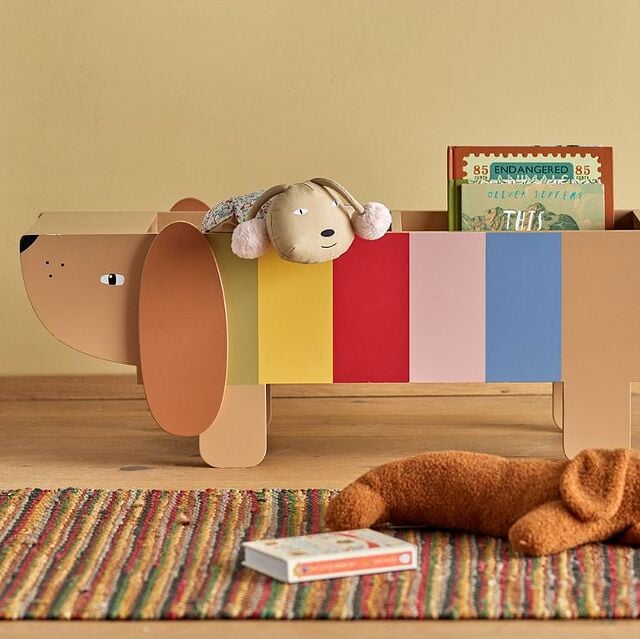
When choosing patterns, consider your child's interests – a bear, lion, unicorn, or dinosaur motif. This makes encouraging independent tidying much easier: “the plushies are going back to their lion,” “the blocks are off to the dinosaur.”
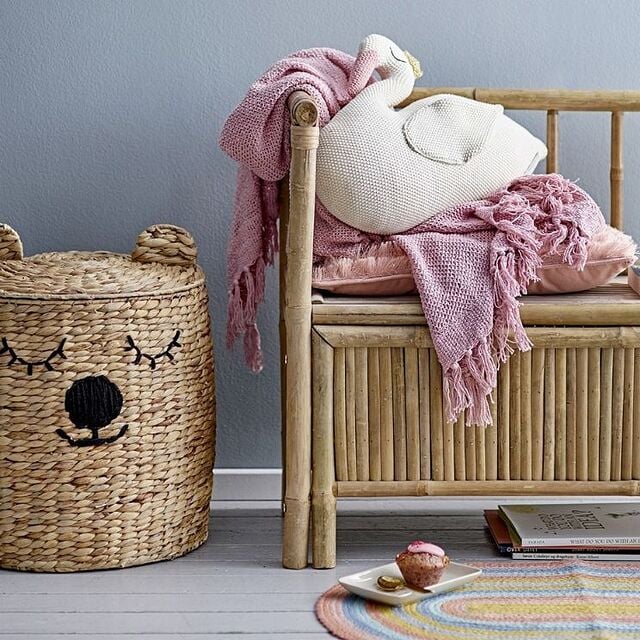


Textile Containers, Baskets, and Toy Bags
Textile containers are gaining immense popularity. Their softness, safety, and trendy boho or Scandinavian minimalist aesthetic appeal to parents looking for something more than just plastic.
Lightweight fabric baskets:
Ideal for plush toys, pillows, blankets
Look great in a child's room corner or by the bed
Thanks to a stiffened bottom, they maintain their shape but are safe if tipped over – no risk of harm to the child
Boucle knit and plush containers (ecru, beige) have a “teddy bear” character. They are pleasant to touch, which little ones appreciate in daily use.
Toy bags:
Work well for building blocks and small items
Some double as playmats (100x100 cm when unfolded)
A good solution for small apartments – sorting toys without occupying permanent floor space
For children with allergies, choose machine-washable textile containers (30-40°C according to the label). Look for OEKO-TEX certifications, especially for infants.
Wheeled Toy Storage and Mobile Solutions
Mobile wheeled containers are a game-changer for the dynamics of small apartments. When a child's room is integrated with the living area, and toys “travel” between spaces daily, wheels truly make all the difference.
Practical advantages:
A child aged 4+ can move the box themselves
Tidying up in the evening is a breeze – “toys go back to their wheeled garage”
You can slide the container under a desk, bed, or into a corner
Wheeled containers often double as mini-seats. When choosing such a model, pay attention to sturdy wheels (TPE/PU, quiet, lockable) and a safe design without sharp edges. The seat's load capacity should be a minimum of 60 kg.
In studio apartments with mezzanines, mobile boxes allow you to keep a set of frequently used toys always at hand. Daily scenarios: evening tidying (5-10 minutes), moving to the living room for the weekend, packing for a trip to grandparents'.
Toy Storage: Ecology and Safety
Parents' ecological awareness is on the rise. In recent years, there's been a growing preference for products that are durable, repairable, and made from recyclable materials. This isn't just a passing trend – it's a fundamental shift in consumption habits.
Why polypropylene (PP) remains popular:
Lightweight, durable, resistant to cracking (impact resistance 10J)
100% recyclable (process: washing, grinding, granulation)
Withstands contact with water and detergents
Operating temperature: -10°C to +60°C
Look for product lines made from recycled plastic (rPP) and fabrics with OEKO-TEX certifications (Standard 100 Class I for infants). These labels guarantee the absence of harmful substances.
Safety considerations:
No sharp edges or small detachable parts
Stability of large chests (base >30% of width)
Weight when filled – a child should be able to move it without difficulty, but the container shouldn't tip over easily
It's a good idea to review the contents of your containers every 3 months. Discard any damaged items, and clean the rest with mild cleaning agents (pH 6–8), especially if your child puts objects in their mouth.
How to Cleverly Plan Toy Storage in a Child's Room
Even the best container won't cut it without a well-thought-out spot in the room. You need a simple system that both an adult and a four-year-old can understand. Statistics show that the average child owns over 200 toys, with 70% remaining unused.
The three-zone rule:
| Zone | Height | What to store | Container type |
|---|---|---|---|
| Floor | 0–30 cm | Daily toys | Large baskets, chests, wheeled |
| Low | 30–100 cm | Games, blocks, dolls | 30x30x30 cm boxes |
| High | >120 cm | Seasonal, rarely used | Lidded boxes for adults |
Labeling:
Pictures (icons of blocks, a teddy bear, books) for children aged 2–5
Labels (“blocks,” “drawing,” “games”) for older children, approx. 5–7 years
Example apartment layout: a wall-mounted shelf with 6-8 modular containers, a large textile basket for plush toys by the bed, a flat wheeled container under the bed for blocks and other children's accessories.
Introduce a simple rule: in the evening, all toys “go back to their home.” Maintaining this ritual helps the child associate tidying with the day's routine, not with punishment.
How to Integrate Children's Toy Storage with Your Home's Overall Aesthetic
Parents in smaller apartments face a unique challenge: without a dedicated playroom, toys need to “play nice” with the decor of the living room or dining area. But clutter doesn't have to take over.
Integration strategy:
In the child's room: more colorful baskets and prints matching their interests
In the living room and hallway: neutral, elegant boxes (e.g., colorful organizers from Hay or Muuto) that blend with the rest of the furniture
Organizers of various sizes can be arranged to create a cohesive look
A great solution is to opt for sets of boxes in a single color palette. This makes it easier to maintain interior harmony, even if they serve different functions (toys, documents, cosmetics, electronic accessories).
When planning your storage, think 5-7 years down the road. Neutral, attractive boxes will remain useful in your home even when your child outgrows plush toys and swaps them for board games, books, or sports equipment. The functionality of well-designed containers truly stands the test of time.
A well-chosen toy storage solution is an investment for years to come. Start with one system – a shelf with modular boxes or an elegant textile basket – and expand it gradually. Good luck!