Whether we're going to a gala, a business dinner at a restaurant or a party with friends, we should follow some basic savoir-vivre rules about how to behave at the table. What can and cannot be done while dining? How to use cutlery and how to put it away? How to eat soups and how to eat fish and meat?
Savoir-vivre at the table - general principles
The right...
behaviour at the table consists of aesthetics of eating as well as complying with certain generally accepted standards. Learn about the general savoir-vivre rules that apply at the table.


- While you're eating hold your left hand on the edge of the table, on the left side of the plate, while in the right hand hold a spoon or a fork, and use this hand to put the cutlery into your mouth, without leaning your elbow against the table. While you're eating do not bend over the plate, just keep the posture straight.
- Food should be eaten slowly. Do not put too much food into your mouth or do not scoop too much of food onto a soup spoon. Eating too loudly is also unacceptable.
- According to the rules of savoir-vivre during a meal you shouldn't leave the table. If you want to reach for a dish or bread standing far from you, you should ask the person sitting next to you for help. You should also remember that you must not reach out in front of someone or give another person a plate in front of a table neighbour. In this case, you should apologize to the person, pass the platter behind his/her back or ask him/her to pass the dish further.
- When taking food off the platter onto your plate, you need to take the piece closest to you. Searching for the right piece all over the plate and touching the other bites at the same time, is against the principles of savoir-vivre. We should also remember that it is not acceptable to put food from a platter with your fork, spoon or knife.
- Your plate should be in place at all times. It must not be lifted closer to your mouth, or brought closer to the platter or bowls for serving. In that case, the bowls should be brought closer to the plate.
- Do not blow onto the meal on your plate. If it is too hot, wait a while until it cools down.
- If you find any an unappealing piece, e.g. fat or cartilage, it should be discreetly put on the edge of our plate in such a way that no one would see it.


How to use cutlery? What does placing the cutlery on the plate mean?
Below there are a few rules on how to use cutlery while you're eating.
- Spoons and forks constitue cutlery for putting food on and putting bites into the mouth, on the other hand knives are used not only for slicing food, but also for helping with getting a meal pieces onto a fork.
- When eating the meal hold the cutlery quite high, and not at the very base of the blade in case of a knife, or not close to the "head" in case of a spoon and fork.
- When you pick up a spoon or a fork and put it close to your mouth, you have to grab it with the first three fingers of the hand, and the last two fingers should be held parallel or contracted - do not bend them upwards.
- As a rule, flour dishes, vegetables, groats and chopped meat should be eaten with a fork alone. The other types of meat should be cut with a knife, holding it in your right hand.
- It is not allowed to play with cutlery and wave with them ...while you're eating or talking.
- Once we take the cutlery from the table, we cannot put it back in the same place. They must also not be leaned against the table. Once used, always put the cutlery on your plate.
- On the other hand, coffe and tea spoons should always be on the saucer, whether a drink has already been poured into a cup or not. Leaving a spoon in a cup or leaning it against a saucer is against savoir-vivre.

Thanks to the appropriate arrangement of cutlery on the plate, we can inform the host, e.g. that we have already finished the meal or we ask for a refill. Below we present generally accepted rules for placing cutlery on a plate and their importance.


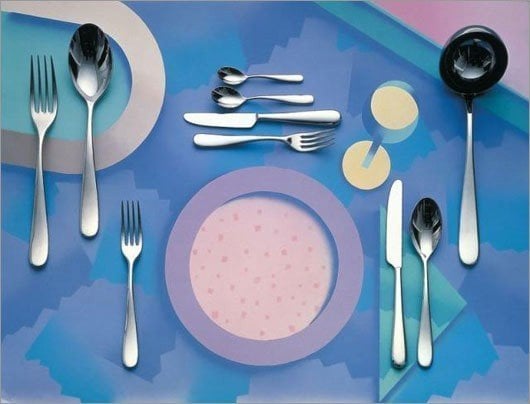
- I'm ready to start my meal - there is a whole set of cutlery next to the plate - on the right side we have the knife with the blade facing the plate, and on the left side - the fork facing upwards, as well as usually there is also a soup spoon.
- Break from eating - we place the fork onto the plate at eight o'clock and knife at four o'clock. With this arrangement, the fork's teeth must not come into contact with the blade of the knife.
- Please give me another meal - cross the knife with the fork in the middle of the plate.
- It was delicious - place the cutlery horizontally on the plate in such a way that the teeth of the fork and blade of the knife are pointing to the right.
- I didn't like it - this message will be conveyed by means of cutlery, by putting the blade of the knife between the teeth of the fork. We put the cutlery prepared in this way on a plate, arranging their handles for five and seven o'clock, respectively.
- Arranging the cutlery after the meal - after the meal is over, we put the cutlery in such a way that their hands indicate the hour 5:20.


Etiquette at the table - how to eat individual dishes?
Since we have already learnt the general rules on how to behave at the table and know how to use cutlery, it's high time we learned how to eat different types of food.


1. Soups
When it comes to eating soup, there are two "schools" with two different ideas on how to eat this meal. One of them says you can eat soup as long as you can get it on the spoon without having to tilt the plate to do so. On the other hand, according to the second school, you can tilt deep plates with soup if you want to eat it, but remember that in this case you always have to tilt the dish away from us. We only put the tip of the spoon into the mouth and in the case of plates or soup bowls – you do not put the spoon deeper than two-thirds of the height of the dish. If there is a larger piece of meat in the soup, we eat soup first, and finally, we eat the meat piece with a knife and a fork. While eating soup we can help ourselves with a fork, if e.g. pasta is hanging off of the spoon, or if there are vegetables sticking out from the spoon that make it impossible to put the spoon into your mouth. In these cases, use a fork to put pasta or vegetables on the spoon. You can drink soup served in a cup by lifting the cup by the handle. You can't do that, if the soup is served in a dish with two ears.


2. Meat
We eat meat dishes with a spoon, a fork and a knife or with the fork itself. The choice of a particular type of cutlery depends on the type of food served. Any kind of goulashes that are served in a soup bowls or ramekins should be eaten with a spoon. Meat dishes from minced, chopped or very finely cut meat are meant to be eaten with the fork itself. Fried or roasted pieces of poultry, pork, beef or other meat served on plates is consumed with a knife and a fork. During cutting, the meat should not be held with the fork in its central part in order to cut a suitable piece. The fork should be immediately hammered into the piece of food we are about to eat.


For many people it is quite problematic to eat meat on the bone, e.g. chicken, ribs or lamb chops. How to eat this type of food? You have to hold meat with a fork with your left hand and with the right hand you have to cut out small pieces. Then, you put a fork into a piece of meat and eat it. If there is meat left on the bones, you can bite them by holding your fingers behind the bone, but only on condition that the host has prepared a special napkin and a bowl of water, in which we can wash our hands after the meal. If we don't get such a set, eating meat with a bone should be finished when we cannot cut more meat with a knife and a fork.


3. Fish
The way fish is eaten depends on the type of food served. Fillets of fish can be eaten with a classic knife and fork. Whereas fish served as a whole, i.e. with skin and bones, is eaten with a special fish cutlery, consisting of a wide three-toothed fork and a wide, blurred and oblique knife, which is not used for cutting but for separating meat and skin from the bones. Whereas fish served as a snack, e.g. marinated herring, smoked salmon or eel, can be eaten with a table fork or with a lunch-snack fork. If you feel a fish bone while eating, you need to use your tongue to put the bone on the fork and then put it on the edge of the plate. In a situation where the bone gets stuck between your teeth, you should leave the table and remove it in a secluded place.


4. Bread
Although the consumption of bread does not seem to be complicated, there are several savoir-vivre rules to follow. First of all, buns, bread or other types of baked goods must not be cut with a knife. Bread served on a small plate is meant to be torn off or broken off, which when divided into smaller pieces are put into your mouth piece by piece. We can spread butter on the pieces of bread that we have broken off. Use a special butter knife to place a piece of butter on your plate and then just spread it on the bread.


5. Spicing up the food
One of the most common blunder at the table is seasoning the food before trying it. It is an expression of mistrust in the skills of the person preparing the meal. After tasting the dish, we can lightly season it with salt or pepper, but asking for additional spices that are not on the table is considered incompatible with savoir-vivre rules.
We are convinced that thanks to our practical advice on the principles of savoir-vivre at the table, you have learnt how to eat meals in an aesthetic and elegant way.