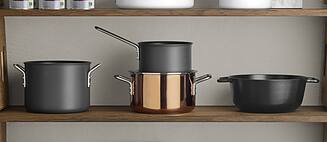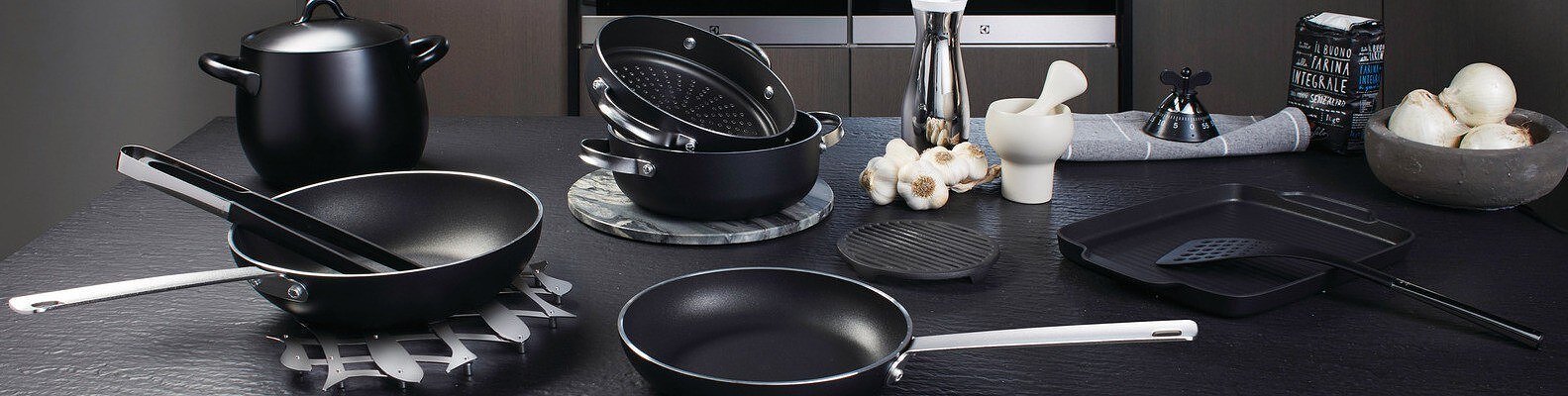
Induction cooktops are gaining more and more followers - and no wonder, since they are efficient and convenient to use, which makes them superior to ordinary electric and traditional gas cooktops. The only problem is that you have to buy special pots and pans that are adapted for this type of cooker. How are these cookware different from others?
How does an induction hob work?
Induction hobs need to be plugged in - and there is only so much they have in common with ordinary electric cookers, as they work on a completely different principle. Hidden beneath the surface of the hob are coils which generate an alternating magnetic field. This fluctuates so rapidly that eddy currents are created in the bottom of the cooker, transforming the electrical energy into heat.
In fact, only the bottom of the pot is hot, while the hob heats up secondarily from the pot, but is still much cooler than in conventional electric cookers. It also cools down very quickly. What does this mean? First and foremost, it means that the risk of scalding is much lower. We will talk about other advantages later in this article.
What is so special about induction cookers?
Induction hobs undoubtedly have many advantages, but when we decide to install one, we also need to invest in a new set of pots and pans, because we can't cook with standard pots and pans. We need special saucepans and pans, the bottoms of which are made of a specific type of metal, called ferromagnetic. It is this metal that, under the influence of the magnetic field generated by the hob, starts to produce heat.
Normal cookware made of 'normal' materials is not 'sensed' by the hob. Therefore, no heat energy is induced and cooking or frying is not possible. Only ferromagnetic metal is 'detected' by the cooker when it comes into contact with its surface.
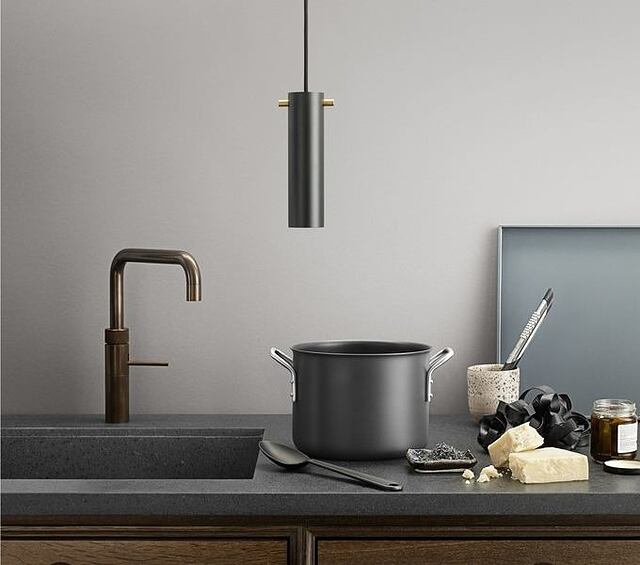
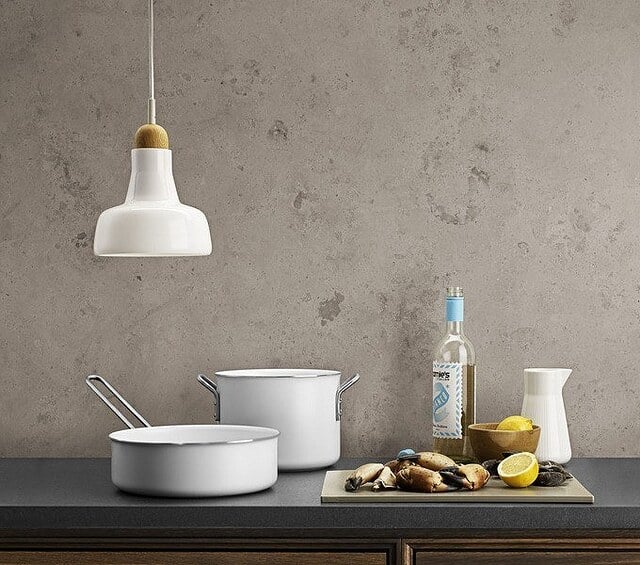
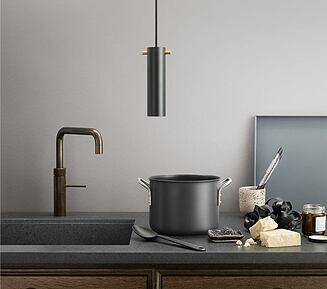
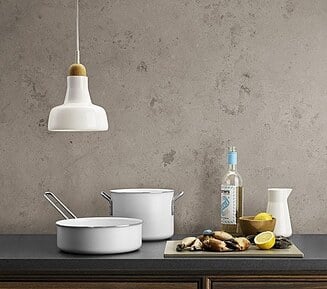
What features do such pots have?
The bottom of induction cookware must also be matched to the heating area on the hob. If it is larger than it, the cooker will not work. The ideal pot has a diameter the same or smaller than the heating area.
The bottom itself should be perfectly flat, without any grooves, so that it fits snugly against the hob, which is also a requirement for its function. However, it does not have to be round - there are also cookware with a rectangular or square bottom, such as those in Silit's Quadro Black collection. Some pots are narrower at the bottom and wider at the top, so they use less energy, heating up faster.
When choosing pots for induction cooking, also pay attention to the type of handles. The best handles are those made of materials that do not conduct heat, which reduces the risk of burns and makes them easier to use. As an example of this, we can mention products from the Eva Solo collection with wooden handles.
It would be good if the lid also had a non-warming handle. It would also be useful if the lid had an opening through which excess steam can escape. Glass lids are the most practical, as they allow you to monitor the cooking or frying process without opening the pot. This is what the Fissler Paris range of pots is equipped with.

Glass, ceramic or metal?
Various materials are used to make induction cookware, the most important thing is just that the bottom reacts to the electromagnetic field. One frequently used raw material, for example, is stainless steel, which looks extremely elegant and is easy to clean. Examples of cookware made of this material include the Alessi - Dressed and Alessi - Mami 3.0 lines. The latter are additionally coated with a black silicone resin coating, which prevents food from sticking.
Cookware for induction hobs can also be enamelled or even ceramic. Some aluminium or copper ones, such as those from the Eva Trio - Dura Line collection, are also suitable, provided they have a ferromagnetic bottom. Most ceramic ones, however, can be discarded outright, as can those made of aluminium, copper and, of course, glass. Among pots that work with magnetic fields, we can find many attractive, designer models, such as those from Silit's Quadro Red collection.
How do I recognise them?
Some cookware suitable for induction hobs can also be used successfully on other types of hobs. It all depends on the base and the material from which they are made. Examples of such cookware are the pots and pans from the Fissler Luno and Eva Trio White Line collections. The latter are so versatile that they are even suitable for ovens.
How can you tell if a pot is suitable for induction cooking? First of all, they should be marked accordingly by the manufacturer. This is done by the characteristic coil symbol, which looks a bit like a ball or a maze. Look for it on the packaging and often also directly on the cookware.
There is also a 'home' way of checking whether a particular cookware will be compatible with an induction hob. For this you need a simple magnet, which you apply to the bottom. If it is attracted by it, the pot is good. Otherwise, it will not be detected by the hob's magnetic sensors.
Why choose an induction hob?
We have already mentioned that one of the advantages of induction cookers is that there is less risk of burning yourself on the hob, which heats up minimally and cools down quickly because the heat is produced at the bottom of the pot. This is a huge plus when there are young children in the house, who by nature like to touch everything. Fans of cats - pets that often jump on kitchen worktops and appliances - will also be pleased.
This method of generating the energy needed to prepare food is also the most economical of those in common use today. Induction hobs and the sets of pots and pans adapted to them are admittedly more expensive than traditional ones, but their purchase will quickly pay for itself in electricity bills - all the more so as they also significantly reduce cooking time.
Induction hobs are characterised by their modern design and have many additional functions. In addition, they are easy to clean because food particles that fall on them do not burn. Pots also do not burn, which significantly prolongs their "life".