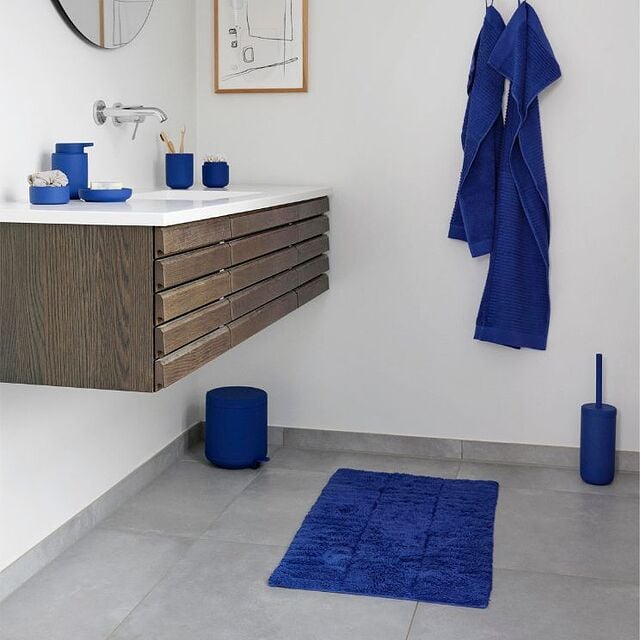
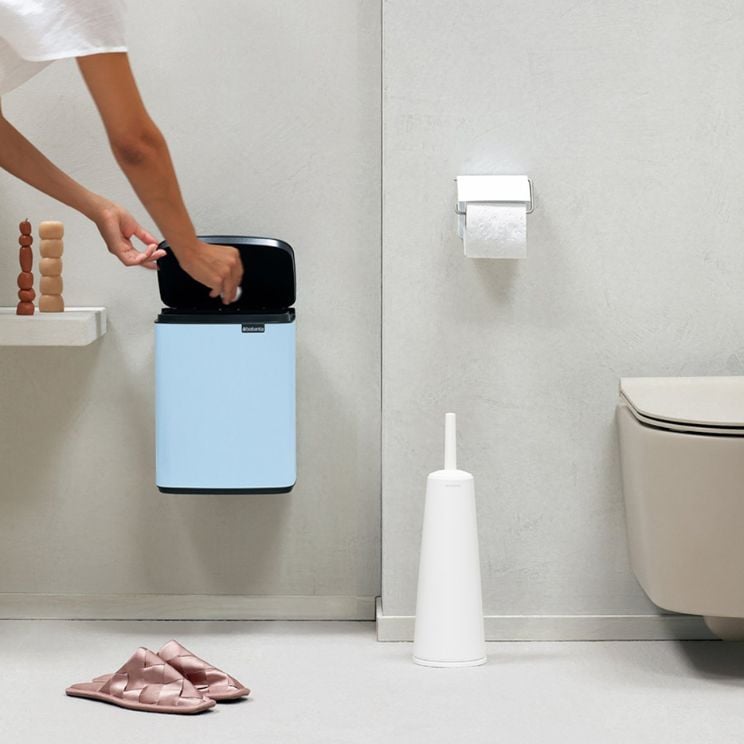
A bin is one of those accessories you usually only notice when… it's missing. Yet, in the bathroom, it plays a crucial role – it should be hygienic, convenient to use, and aesthetically pleasing enough to harmonize with the entire interior. Discover which models we recommend!
Which bathroom bin should you choose?
Choosing the right bathroom bin is often overlooked, yet it's a crucial element in designing a functional and hygienic interior. Unlike a kitchen or office, a bathroom bin must meet specific challenges, such as high humidity, limited space, and the need for maximum discretion. The answer to the question: bathroom bin – which one to choose? requires a thorough analysis of materials, opening mechanisms, capacity, and design.
Why does choosing the right bathroom bin matter?
The bathroom is its own microclimate. It's a space where factors like condensation and temperature fluctuations are the norm. A bin that might be made of any material in other rooms must be a piece of equipment with increased corrosion resistance and ease of cleaning in the bathroom. Treating it as a random piece of furniture is a mistake, leading to rapid deterioration, unpleasant odors, and a lowering of hygiene standards.
Humidity and hygiene
Humidity is the biggest enemy of most bins made from lower-quality metals. In contact with water and steam, standard steel quickly rusts, leading to unsightly stains and the need for replacement. That's why it's so important to choose a model made from technologically advanced materials that ensure long-lasting aesthetics and durability. What's more, due to the nature of waste (e.g., cotton, tissues, hygiene products), a hermetic sealing system becomes a priority, effectively blocking the spread of odors and ensuring discretion.
Functionality and aesthetics
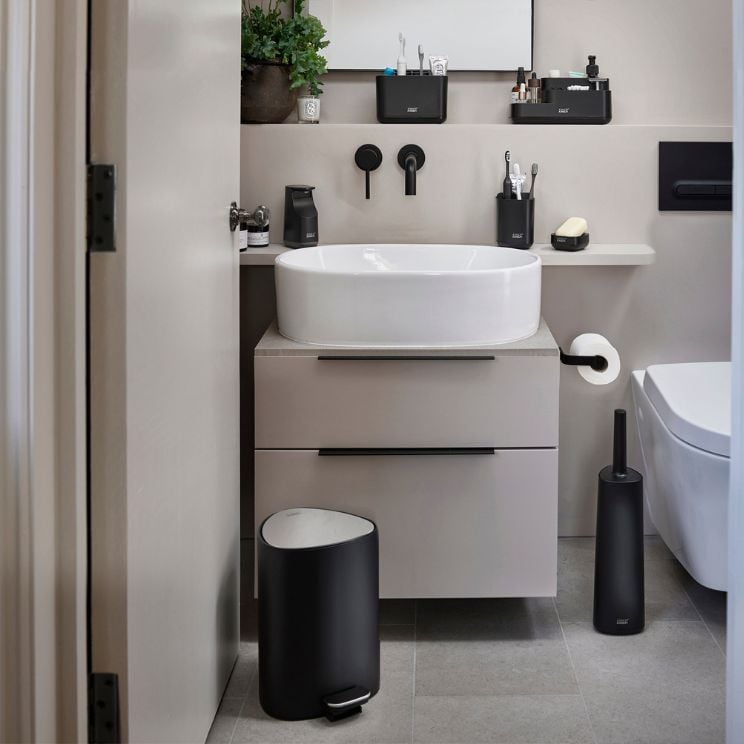
Modern bathrooms, often designed with minimalism in mind, don't tolerate random items. A bathroom bin should be consistent with the rest of the fixtures and accessories – whether in terms of color (chrome, black, white) or finish (matte, gloss). For example, in industrial bathrooms, steel bins with a matte, brushed finish will work perfectly. In classic, white interiors, a white bin with a subtle pedal will be a good choice. Functionality must go hand in hand with design, creating a harmonious whole.
How to choose the ideal size for a bathroom bin?
One of the most common questions regarding bathroom bins concerns their capacity. Unlike a kitchen bin, a bathroom bin is not for storing large amounts of bulky waste, but rather for regularly disposing of small items. The key here is the frequency of emptying.
3-liter, 5-liter, or 10-liter bin?
3-liter capacity: Ideal for small bathrooms for one person or a guest toilet, where the amount of waste is minimal. Such a bin is discreet, easy to hide, but requires very regular (e.g., daily) emptying.
5-liter capacity: This is the standard and most frequently chosen size. Optimal for 2-4 person households. Such a bin holds enough waste for 2-3 days before it needs emptying, while maintaining compact dimensions.
10-liter capacity and more: Recommended for large, family bathrooms or places with very intensive use (e.g., offices, clinics). It provides greater autonomy but takes up more space and is more visible. In this case, particular attention should be paid to odor control systems.


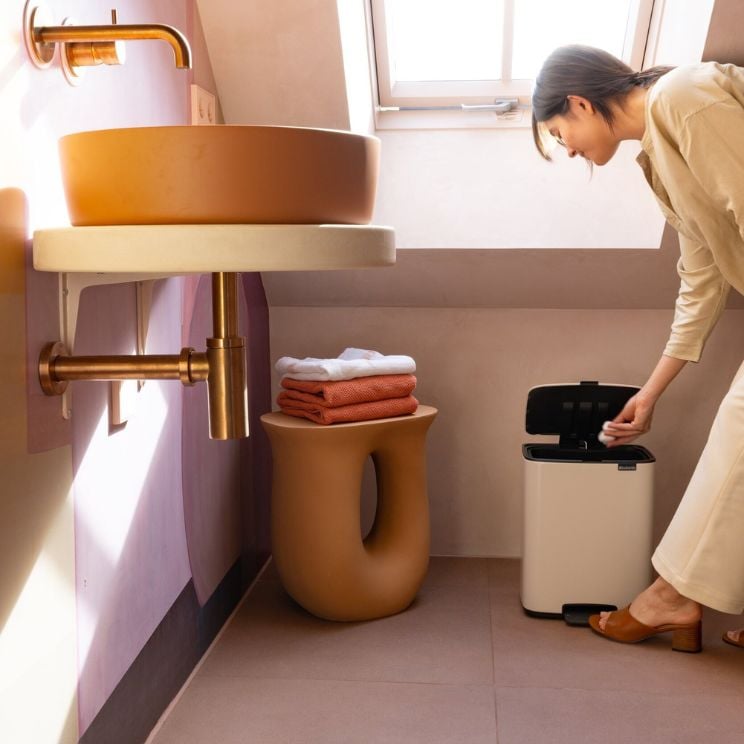
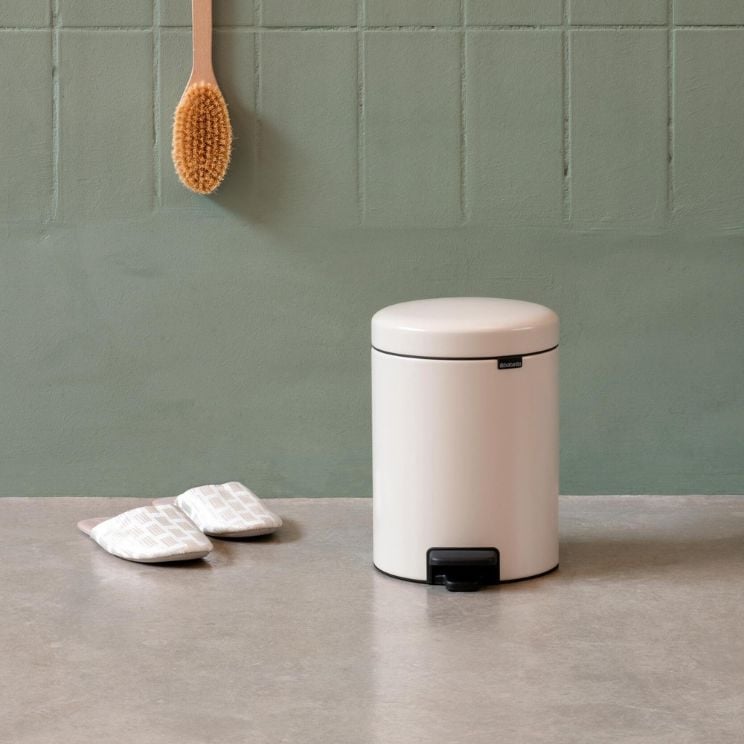


The principle of proportionality in small and large bathrooms
When choosing the size, the principle of proportionality should be applied. In a small bathroom (e.g., 3-4 m²), a large, 10-liter bin will disrupt harmony and be a dominant element. In such a case, it's worth considering narrower, elongated (slim) models that optimize space. Conversely, in spacious bathing salons, a small 3-liter bin may look disproportionate and require unjustified regular emptying. We always measure not only the capacity but also the base area of the bin.
Materials and technologies: which bathroom bin will work best?
The durability of a bathroom bin directly depends on the material it's made from. Investing in a better raw material minimizes the risk of corrosion, facilitates disinfection, and guarantees a longer lifespan.
Stainless steel – advantages and disadvantages
Stainless steel (18/8 or 18/10 grades, often marked as AISI 304) is the gold standard in the production of high-quality bathroom accessories. Its key advantages are:
Corrosion resistance: Thanks to its chromium content, steel forms a passive protective layer that prevents rusting in a humid environment.
Ease of cleaning: The smooth surface allows for quick removal of dirt and disinfection.
Disadvantage: High-gloss (polished) models are very susceptible to fingerprints and smudges. Therefore, experts often recommend bathroom bins made of brushed (matte) steel, which are much less troublesome to keep clean on a daily basis.
FFP coating
For stainless steel bins, it's worth paying attention to models with a Fingerprint Proof (FFP) coating. This special finish prevents fingerprints, smudges, and minor dirt, making the bin look fresh even with intensive use. In a bathroom, where steel easily picks up moisture and handprints, this technology really makes a difference.
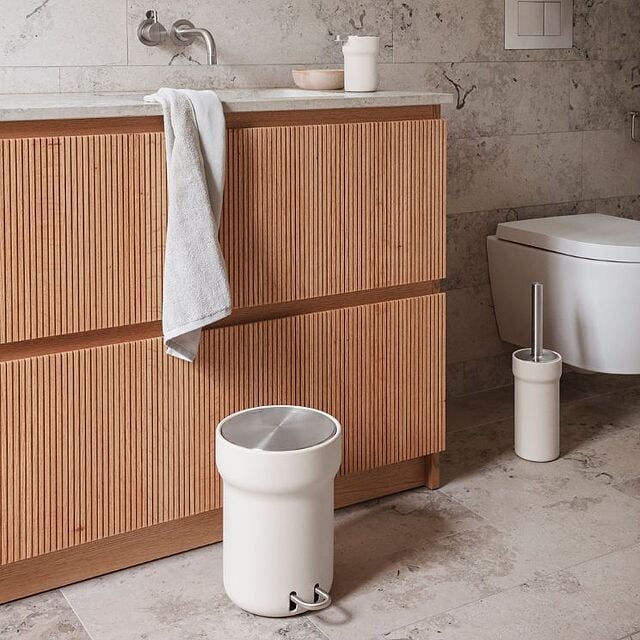
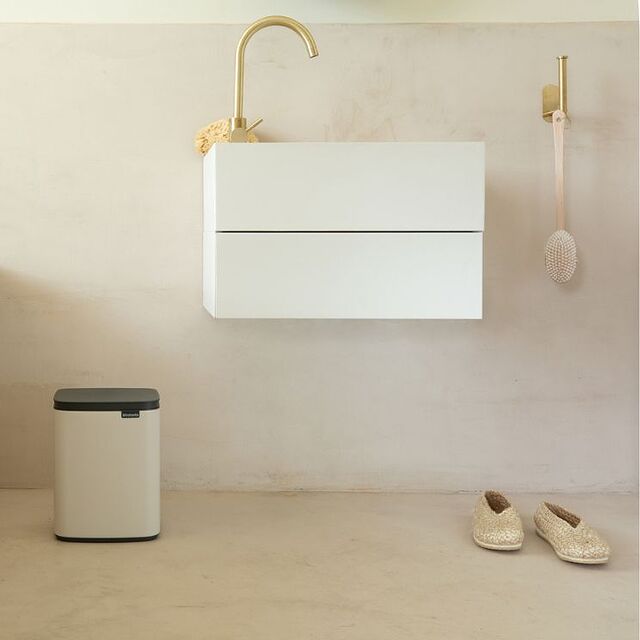
Brabantia is one of the brands that has perfected it – their bins are not only elegant and scratch-resistant but also exceptionally easy to maintain, which will be appreciated by anyone who likes to keep things tidy without unnecessary effort.
You can learn more about bins from this brand in our article Brabantia Bin. You'll want to show it off.




Plastics. When is plastic better than metal?
Modern bins made of high-quality plastics (e.g., impact-resistant ABS or flexible polypropylene) offer an attractive alternative, especially in terms of price.
100% Rust resistance: Plastic is completely impervious to moisture and water.
Lightweight: Easy to move and clean.
Color variants: Greater availability of intense and unusual colors that can serve as a strong decorative accent.
Plastics are a particularly good choice when the bathroom bin needs to be frequently cleaned with aggressive disinfectants or in places where it might get wet (e.g., near the bathtub/shower). However, it's worth avoiding the cheapest, brittle plastics that crack easily and fade quickly.


Bathroom bins with antibacterial coating
In the premium segment, some models of steel or plastic bins are coated with special antibacterial coatings, often containing silver ions. This is an advanced technology aimed at:
Bacteria reduction: Limiting the multiplication of microorganisms on the bin's surface.
Odor reduction: Fewer bacteria translate into more effective control of unpleasant smells.
Although this is a more expensive option, it significantly raises the standard of hygiene, which is important for a bathroom bin.
What is PVD coating?
PVD coating is one of the most advanced steel finishing technologies – extremely durable, resistant to corrosion and scratches, while maintaining a deep, elegant color for years.
PVD coating is created in the process of Physical Vapor Deposition. This is a technology in which metals or metal compounds are evaporated in a vacuum and then deposited on the steel surface as an extremely thin but exceptionally hard layer. As a result, the color becomes deep and saturated, and the coating itself – resistant to abrasion, corrosion, high humidity, and daily use.
Opening mechanisms: what to look for when choosing a bathroom bin?
The way a bin opens directly affects convenience and hygiene of use. In the bathroom, the priority is to avoid direct hand contact with the lid.
Foot pedal bins – convenience and hygiene
Pedal bins are standard in bathrooms due to their hygiene. They allow the lid to be opened with a foot, which is crucial when you have wet hands or want to maintain maximum cleanliness.
Important aspects when evaluating a pedal bin:
Pedal durability: Check if the mechanism is metal, not plastic. A metal pedal and a solid cable mechanism guarantee reliability for years.
Non-slip base: The bin should not slide on tiles when the pedal is pressed.


Soft-Close system (silent closing) – user comfort
High-quality bathroom bins are often equipped with a silent closing system (Soft-Close). This is a hydraulic or pneumatic mechanism that slows down the lid's descent, eliminating a loud bang. While it may seem like a minor detail, at night or in small apartments where sound travels easily, the Soft-Close system significantly enhances user comfort. This is one of the indicators that distinguishes a cheap bin from a premium model.
Touchless (sensor) bins – is it worth investing in technology?
Motion sensor (sensor) bins represent the pinnacle of convenience and hygiene. The lid opens automatically when a hand approaches the sensor and closes after a short while.
Is it worth choosing a sensor bin for the bathroom?:
Advantages: Maximum hygiene, no contact (ideal for offices and modern bathrooms).
Disadvantages: Battery-powered (requires regular replacement or charging), higher price, risk of accidental opening (if the sensor is too sensitive or the bin is in a narrow passageway).
Summary: Investing in a sensor bin is justified when hygiene is a priority and the user is prepared for regular power maintenance.
Aesthetics and design: the bin as a decorative accent
Bathroom bin – which one to choose from a visual perspective? Currently, many models are available on the market that blur the line between a utilitarian and a decorative item.
Hidden bins: built-in and integrated with furniture
In modern bathroom design, completely hiding the bin is becoming increasingly popular. This can take the form of:
A bin integrated into a drawer: A small, removable container placed inside a drawer under the sink. Opening the drawer automatically reveals the bin.
Recessed into the countertop: A very discreet solution where only a small, round flap on the countertop is visible, and the entire bin is located underneath in the cabinet.
These solutions are aesthetic but require planning at the furniture design stage and are usually more expensive.
Color and finish: matte, gloss, texture – matching the fixtures
Choosing the color is crucial for visual consistency:
Chrome/Gloss: Best suited for classic, high-gloss fixtures.
Matte black/Matte white: Dominant trends in modern bathrooms, ideal for black or gray fixtures. A matte finish is also more practical (fewer visible fingerprints).
Gold/Copper/Brushed Steel: Premium finishes, suitable for luxurious, designer arrangements.
Construction aspects – why is an inner liner essential?
Regardless of whether you choose a metal or plastic bathroom bin, its functionality largely depends on its internal construction.
Removable liner – the basis of hygiene
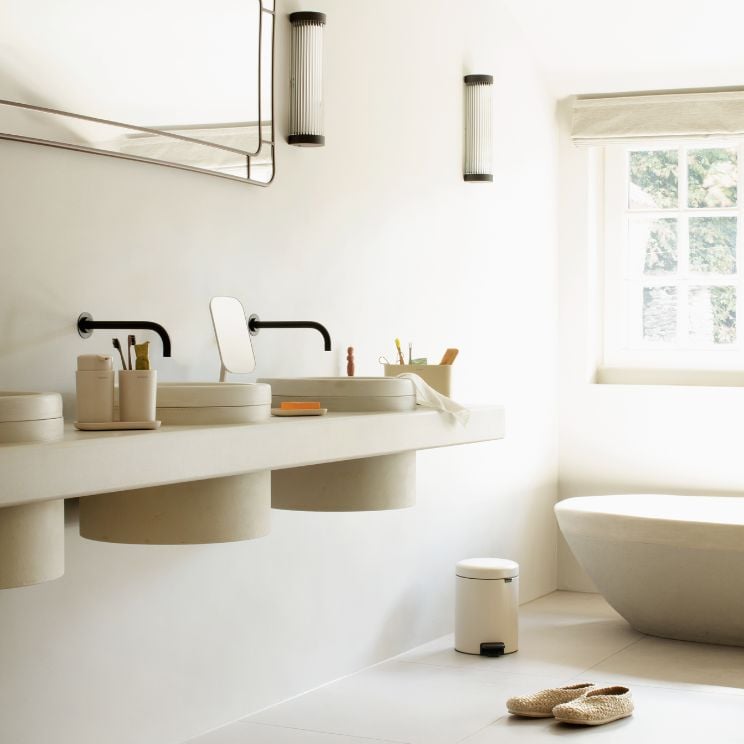
A removable, internal container (bucket) is an absolutely key element. It allows for hygienic emptying of the bin and its cleaning without having to move the entire outer body.
Liner material: Should be made of smooth, durable plastic (polypropylene) that is easy to disinfect.
Handle: The liner must be equipped with a solid metal or plastic handle for easy removal.




Bag fastening system: no more protruding edges
The aesthetics of a modern bathroom bin require that the bin liner be completely invisible. Manufacturers solve this problem in several ways:
Clamping ring: The simplest solution – after placing the bag, a plastic or metal ring is placed over it, holding the edge and hiding it under the lid.
Hidden holes in the bucket: The inner bucket has special holes for tucking in excess bag material.
Dedicated bags: Some manufacturers (e.g., Simplehuman) offer bags perfectly matched to the shape and size of the bin, eliminating the problem of protruding edges.
Common mistakes when buying and using a bathroom bin
To avoid disappointment and the need for quick replacement of equipment, it's worth knowing the pitfalls consumers fall into.
Ignoring the bag fastening system
By choosing a model that has no system for hiding the bag, the user is condemned to unsightly protruding, loose bag edges, which ruins the look of even the most beautiful bin. Always verify this element before purchasing.
Choosing a bin without a removable liner
Buying a bin where the entire body is also the container is a serious mistake. Emptying such a bin is unhygienic, and cleaning it is difficult. Additionally, if damaged (e.g., a crack at the bottom), the bin becomes useless.


Errors in cleaning and disinfection
Even the best bathroom bin requires regular care.
Mistake: Cleaning stainless steel with chlorine-containing agents or abrasive sponges. This leads to damage to the passive protective layer and scratches, which accelerates corrosion.
Tip: For stainless steel, use dedicated inox cleaners or mild soapy water. Disinfect the plastic liner with a mild alcohol- or vinegar-based solution.
How much should a good bathroom bin cost and what determines the price?
The prices of bathroom bins range from a dozen zlotys to several hundred. This disparity is not accidental and results directly from the level of technologies implemented and materials used.
What influences the cost of buying a bathroom bin?
Material: Bins made of 18/10 stainless steel or durable, powder-coated metal are more expensive than polypropylene bins.
Opening mechanism: The Soft-Close system and a solid, metal pedal increase the price. Sensor bins are the most expensive.
Internal construction: Models with a removable liner, an internal clamping ring for the bag, and a ventilation system (holes in the inner bucket) are more advanced and more expensive.
Brand and Warranty: Reputable manufacturers often offer 5, 10, or even 15 years warranty on mechanisms, which is included in the higher price but ensures peace of mind for a long time.
Recommendation: A high-quality bin is a fully justified investment – it eliminates the risk of corrosion, the problem of noise, and ensures long-lasting aesthetics. In the long run, it's a saving, resulting from not having to replace the product.
Summary - what to look for when choosing a bathroom bin?
When choosing a bathroom bin, don't just be guided by the price. Remember that it is an element that will be subjected to intensive use in difficult conditions. When choosing a bin, pay attention to its capacity, material, opening mechanism, and type of liner.
Decision-making process step by step
Capacity: Decide whether you need 3L (for a single/guest) or 5L (for a family). Don't overdo the size.
Material: Opt for stainless steel (brushed) or high-quality plastic (ABS/PP). Avoid low-quality chrome-plated steel, which will rust quickly.
Mechanism: Choose a pedal bin with a Soft-Close system. This is the optimal combination of hygiene, convenience, and durability.
Liner: Make sure the bin has a removable inner liner and a bag masking system.
A properly chosen bathroom bin becomes an invisible but reliable partner in maintaining cleanliness and aesthetics in your home, meeting all functional and hygienic requirements. It is an investment in details that build quality of life and visual harmony of the interior.
Are you wondering about choosing a kitchen bin? Check out our guide: Which kitchen bin to choose?